


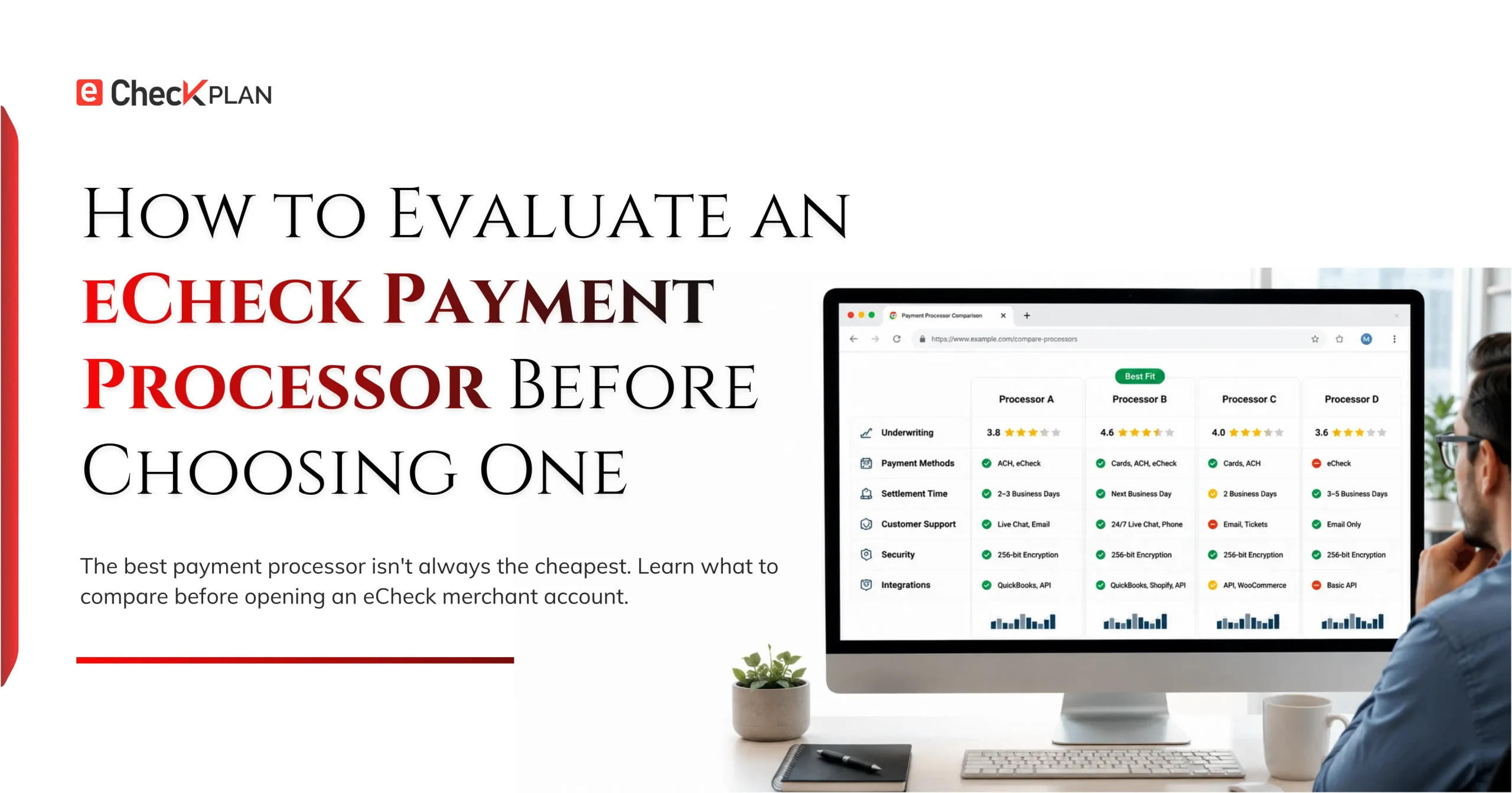
How to Evaluate an eCheck Payment Processor Before Choosing One
One question businesses often ask after comparing several providers is, “How do I know which eCheck payment processor will still work for my business a year from now?“
That’s a better question than asking who has the lowest advertised rate.
Changing payment processors is rarely just a software change. It can affect customer payment habits, cash flow, accounting workflows, payment reconciliation, customer support, and even underwriting. A provider that looks inexpensive during the sales process can become expensive if funding delays, unexpected reserves, or limited support interrupt daily operations.
The most successful merchants don’t start by comparing pricing pages. They start by understanding how each provider evaluates their business, supports their payment workflow, and manages risk after the account is approved.
Table of Contents: —
- Start by Evaluating Your Own Business: —
- Which Businesses Usually Fit eCheck Payment Processing Well?
- When eChecks May Not Be the Best Primary Payment Method: —
- Evaluate the Provider Before You Evaluate the Pricing: —
- Evaluate Every Processor Across Four Areas (Framework): —
- Merchant Account or Payment Aggregator?
- One Underwriting Mistake That Delays More Applications Than Merchants Expect: —
- Frequently Asked Questions: —
Start by Evaluating Your Own Business: —
Many merchants compare processors before understanding what they actually need. That usually leads to comparing the wrong things.
Before requesting proposals, document how your business accepts payments today—not how you hope it will in the future.
Ask yourself:
- Are most payments one-time or recurring?
- Are customers consumers, businesses, or both?
- Are invoices typically paid immediately or over several days?
- What is your average transaction amount?
- Do customers authorize payments online, over the phone, or after receiving an invoice?
- Are payments concentrated around certain days each month?
These answers influence underwriting, payment workflows, and the type of merchant account that makes sense.
For example, a company collecting 600 monthly subscription payments has very different operational needs than a contractor collecting five large invoices each week. Comparing them using the same evaluation criteria produces poor decisions.
Which Businesses Usually Fit eCheck Payment Processing Well?
The strongest candidates generally share one characteristic: Customers already expect to pay from a bank account.
That expectation matters more than industry.
Examples include:
| Business Type | Why eCheck Processing Often Fits |
| Property Management | Monthly rent collection |
| B2B Distributors | High-value invoices |
| Healthcare Practices | Payment plans and patient balances |
| Legal Firms | Retainers and trust replenishments |
| Insurance Agencies | Premium collections |
| Educational Organizations | Tuition payments |
| Payroll Services | Business-to-business collections |
| Accounting Firms | Recurring client billing |
| Membership Organizations | Scheduled monthly payments |
| Contractors | Progress billing and large invoices |
Notice that these businesses don’t simply “accept payments.”
They routinely collect authorized payments after an invoice, agreement, or recurring billing arrangement has already been established.
That distinction influences how payment workflows should be designed.
When eChecks May Not Be the Best Primary Payment Method: —
A payment processor should support how customers naturally pay. It shouldn’t force customers into a payment method that creates friction.
Businesses relying on impulse purchases, immediate checkout, or in-person transactions often see stronger customer adoption through card payments or digital wallets.
Examples include:
- Restaurants
- Coffee shops
- Convenience stores
- Retail boutiques
- Food trucks
That doesn’t mean eCheck payment processing has no place.
Many of these businesses still use it successfully for:
- Commercial customers
- Large special orders
- Wholesale invoices
- Monthly billing
- Vendor payments
The question isn’t whether your business can accept eChecks.
The better question is: Which payments should be collected by eCheck instead of by card?
Merchants that answer this first usually build more efficient payment operations.
Evaluate the Provider Before You Evaluate the Pricing: —
One pattern appears repeatedly during merchant onboarding.
Businesses spend hours comparing transaction fees and almost no time understanding how the provider operates.
Pricing is visible.
Operational quality usually isn’t.
A processor influences far more than payment acceptance.
It affects:
- underwriting decisions
- account reviews
- settlement timing
- customer payment experience
- dispute handling
- bank communication
- payment reporting
- technical support
Those factors rarely appear on comparison pages.
They’re discovered after the contract is signed.
Evaluate Every Processor Across Four Areas (Framework): —
Instead of comparing long feature lists, score every provider using the same four categories.
1. Underwriting Fit:
Ask:
Does this provider understand my business model?
Experienced underwriting teams ask detailed questions.
They want to know:
- what you sell
- how customers authorize payments
- average transaction amounts
- refund procedures
- billing frequency
- customer acquisition methods
Some merchants interpret these questions as obstacles.
They’re actually a positive sign. Good underwriting reduces surprises after approval.
One warning sign is a provider promising approval within minutes without discussing your business.
Eventually someone has to evaluate the risk. The only question is whether it happens before processing starts or after transactions begin.
2. Operational Fit:
Every payment workflow is different.
For example:
A contractor may only need:
- emailed invoices
- virtual terminal access
- recurring customer records
An online subscription company may require:
- API integration
- recurring billing
- customer payment vault
- automated notifications
- accounting integrations
Buying unnecessary functionality increases complexity without improving operations.
Choose software that supports your workflow—not software with the longest feature list.
3. Financial Fit:
Most merchants immediately compare processing fees. That should happen later.
First understand everything that affects your cash flow.
Questions worth asking include:
- When does settlement begin?
- What is the daily processing cutoff?
- How are weekends handled?
- Are reserve requirements possible for my business model?
- How are unusually large transactions reviewed?
- Can transaction limits change after approval?
These questions reveal far more about long-term operating costs than comparing two providers with a few cents difference in transaction pricing.
4. Support Fit:
One practical recommendation we often give merchants:
Call support before becoming a customer.
Not sales.
Support.
Ask a technical question.
Notice:
- how quickly someone answers
- whether they understand payment processing
- whether they answer confidently
- whether they transfer you repeatedly
Sales teams are designed to help you become a customer.
Support teams determine your experience afterward.
Testing them before applying provides useful information that marketing material cannot.
Merchant Account or Payment Aggregator?
Many businesses assume these options differ only in pricing. The more significant difference is how risk is managed.
Payment aggregators generally approve merchants quickly because many businesses operate within a shared payment environment.
Dedicated merchant accounts involve more underwriting before activation because the provider evaluates your individual business.
Neither approach is automatically better.
The decision depends on operational needs.
| Consideration | Payment Aggregator | Dedicated Merchant Account |
| Initial Setup | Faster | More documentation |
| Underwriting | Standardized | Business-specific |
| Account Flexibility | Limited | Greater customization |
| Relationship With Provider | Shared model | Direct account relationship |
| Better Suited For | Smaller or occasional processing | Established or growing businesses |
Merchants processing larger invoices, recurring payments, or higher monthly volume often prefer dedicated eCheck merchant accounts because underwriting expectations are established early rather than during ongoing account reviews.
That doesn’t eliminate future reviews.
It usually makes them more predictable.
One Underwriting Mistake That Delays More Applications Than Merchants Expect: —
Businesses often prepare financial statements while overlooking something much simpler.
Inconsistent business information.
Examples include:
- LLC name differs from the bank account.
- Website displays a different company name.
- IRS records don’t match formation documents.
- Old addresses remain on invoices.
- Domain ownership differs from business ownership.
None of these necessarily prevent approval.
They often require additional verification.
One practical way to avoid delays is to compare every document before applying.
If your legal business name appears differently on five documents, underwriting will eventually ask why.
It’s easier to resolve beforehand than during the approval process.
Frequently Asked Questions: —
The best fit depends on how your customers prefer to pay and how your business collects payments. If you regularly invoice customers, offer recurring billing, or process higher-value transactions, an eCheck payment processor may be a practical option. Businesses that rely on fast, in-person purchases often use eChecks alongside card payments rather than as their primary payment method.
Before opening an account, ask questions such as:
- What documents are required during onboarding?
- Which payment methods do you support besides eChecks?
- How does the underwriting process work?
- What are the expected settlement timelines?
- Will I have access to technical support after my account is approved?
- Are there any transaction or volume limits I should know about?
These questions help you compare providers beyond pricing.
Requirements vary by provider, but businesses are often need to provide documents that verify their legal business name, ownership, banking information, and business operations. Before applying, make sure your business name, tax records, bank account, and website information are consistent to help avoid unnecessary delays during underwriting.
Many payment processors support multiple payment methods, including eChecks, ACH payments, and credit card processing. Choosing a provider that offers multiple payment options can simplify payment management and make it easier to support changing customer preferences without switching providers later.
A payment aggregator allows multiple businesses to process payments under a shared platform, while a dedicated merchant account is established specifically for your business after underwriting. The right choice depends on your business model, payment volume, and operational requirements.
Not necessarily. Processing fees are only one part of the decision. Businesses should also evaluate underwriting, settlement expectations, customer support, available payment methods, reporting capabilities, and how well the provider fits their payment workflow.
In many cases, yes. The transition depends on your existing payment setup and whether recurring payment information or integrations need to be updated. Before switching providers, ask how customer payment data, recurring billing, and payment workflows will be migrated to minimize disruption.
One of the most common mistakes is comparing providers only by advertised pricing. Businesses often overlook underwriting requirements, support quality, settlement expectations, and payment workflow compatibility. Evaluating these factors before signing an agreement usually leads to a better long-term decision.
Approval timelines vary depending on your business model and the documentation required during underwriting. Before applying, ask your provider what information is needed upfront and whether additional verification is common for your industry. Submitting complete and consistent business information can help reduce delays.
In most cases, yes. Your business bank account is generally separate from your payment processor. Before switching, confirm how recurring payments, customer authorizations, and payment integrations will be handled to ensure a smooth transition.
Before choosing any provider, compare at least three processors using the same evaluation criteria—not just pricing. Ask each provider the same underwriting, settlement, support, and integration questions. The right processor should fit your business model today and continue supporting it as your payment volume grows.
 ChatGPT
 Grok
Grok Claude
 Perplexity
 Google Search