Say goodbye to high fees
Switch To eCheckplan For Simple Secure Processing.
Payments made easy, the way they should be.
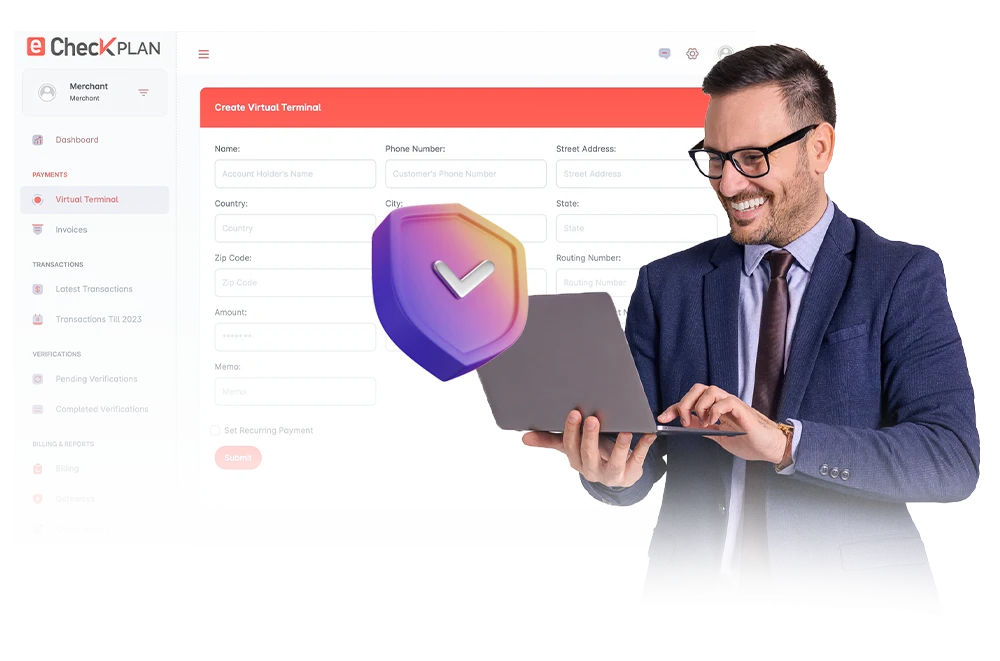
We hope that this FAQ section will help you get a clear picture and remove any doubts that you may still be having pertaining to eChecks. eCheck or electronic check is nothing but the electronic/digital version of old conventional checks. eChecks are processed over the ACH (Automated Clearing House) network. The whole process consists of 4 steps: authorization, payment set-up, finalization/submission of the request and finally confirmation of payment.
Curious about electronic check payment processing? Learn what it is, how it works, and who can use it—plus more answers in our FAQ section!
The 'e' simply means electronic. eCheck or electronic check is nothing but the electronic/digital version of old conventional checks. Yes, you might still be using those paper checks, eCheck is just their evolved form. eChecks are completely electronic and do not use an inch of paper during the whole transaction cycle. They use digital signatures for authentication and funds are transferred between the bank accounts once the eCheck is cleared. However, in some ways eChecks are similar to paper checks; they contain the same info like routing nos, checking A/C no, the amount payable, etc. They can also bounce and can be cancelled just like conventional checks.
First, we will understand the different components or fields in an eCheck: Bank name and address, Name of the payer with address, Date when the eCheck is made out, The number of funds to be transferred, 9 digits routing number, Bank account number of the payee, Check number, Transit code for the eCheck.
eChecks are processed over the ACH (Automated Clearing House) network. The process consists of 4 steps:
1. Check Verification: Payee and payer agree to an eCheck transaction. The merchant verifies authorization details.
2. Setting up payment: Details are entered into the processing software. Recurring payments are marked here.
3. Submission of request: The merchant hits submit and the eCheck enters the ACH transaction process.
4. Confirmation of payment: ACH network clears the transaction, funds are debited from the payer and credited to the payee.
Businesses that indulge in regular transactions can use eChecks for sending/receiving payments on the internet.
eChecks are basically electronic checks, mostly they are electronically used and processed. However, you can also print these on normal printing papers.
It can take from a few minutes upto 2-3 business days to get on-board the eCheck payment service.
Consumer checking account, corporate checking account, saving account and consumer accounts can be used to credit and debit eCheck transactions.
Yes, you can make one time payments with eCheck services.
Yes, you can opt for recurring payments with eCheck services. eChecks are the preferred way to make recurring payments.
Verification of eChecks can be done any day, sales and refunds can be also submitted any day of the week but funds will only be settled only on open bank days, i.e. Monday to Friday and on Saturday in some organizations.
eChecks are usually sent out in bulk for processing by the merchant's eCheck service provider to the ACH network.
Yes, as long as the eCheck transaction is not already in progress it can be annulled or made void.
Consumers bank with their checking accounts can reject eChecks due to a number of reasons like insufficient funds, unfunctional account, discrepancies in eCheck related details etc.
eCheck funds can be settled next day or within 2-3 days at the earliest.
Report to the police and cyber crime unit in your area immediately as soon as you notice discrepancies in your eCheck payment books or smell foul play.
ACH stands for Automated Clearing House, and it is responsible for clearing all kinds of electronic and digital payments. From depositing your salary to processing debit/credit transactions, ACH takes care of it. The network communicates between banks telling where to debit money from and where to credit it. ACH transfers are beneficial since they have low fees, are fully automated, and do not require human interference.
1. Check your bank account balance: Ensure you have sufficient balance as eChecks clear fast and can bounce.
2. Fill up the eCheck request form: Complete authorization online, via software, or phone to pass accurate info to the provider.
3. Check details and press submit: Verify for errors and click submit. Your part only takes a few minutes.
1. Large amount transactions: Minimum processing charges make them ideal for moving large funds.
2. Recurring payments: Perfect for rent, subscriptions, and utilities.
3. In place of paper checks: Safer, faster, and eco-friendly.
4. Lack of funds on other systems: Float time of 3-4 days allows time to arrange funds.
5. Ecommerce: Great for payments where immediate delivery is not pressing.
6. Ease for customers: Offers convenience and attracts more customers.
7. Low fees: Transaction fees are lower than credit cards.
8. Playing it safe: Often no set-up fees and instant hook-up.
9. No devices required: No POS machines needed, perfect for small businesses.
1. SAFER TO USE: Less prone to fraud and cyber intrusions.
2. GREATER ACCURACY: Verified at several levels; discrepancies can be promptly cancelled.
3. SPEED OF TRANSACTION: Quick merchant payouts and fast international transactions.
4. LOWER TRANSACTION FEES: Least transaction fees in the market.
5. USER FRIENDLY: Convenient and easy to fill out.
6. ECO-FRIENDLY: Paperless and sustainable.
7. LOW RISK: Verified at several stages; handles high-risk transactions safely.
8. ZERO SET-UP FEES: Most providers hook you up almost instantly.
9. HASSLE FREE: Totally digital system compared to conventional checks.
Fraud usually involves theft of account and routing numbers from invoices or eChecks. Cyber attackers use phishing to install keyloggers. Protecting yourself involves staying alert to suspicious emails, monitoring accounts daily, and using blocking mechanisms. Report any unauthorized deductions to the police immediately.
Setup fee: Minimal one-time fee (often free).
Monthly fee: Charged for availing services.
Per transaction fee: Percentage or flat rate, usually lower than cards.
Chargeback fee: Charged fof incomplete/cancelled or refund transactions.
High-risk industries (adult, tech support, ecommerce) use eChecks because they offer stable processing where cards might fail. Advantages include low processing fees, safety, and an easy payment option for customers without cards.
Payments made easy, the way they should be.
 ChatGPT
 Grok
 Claude
 Perplexity
 Google Search