

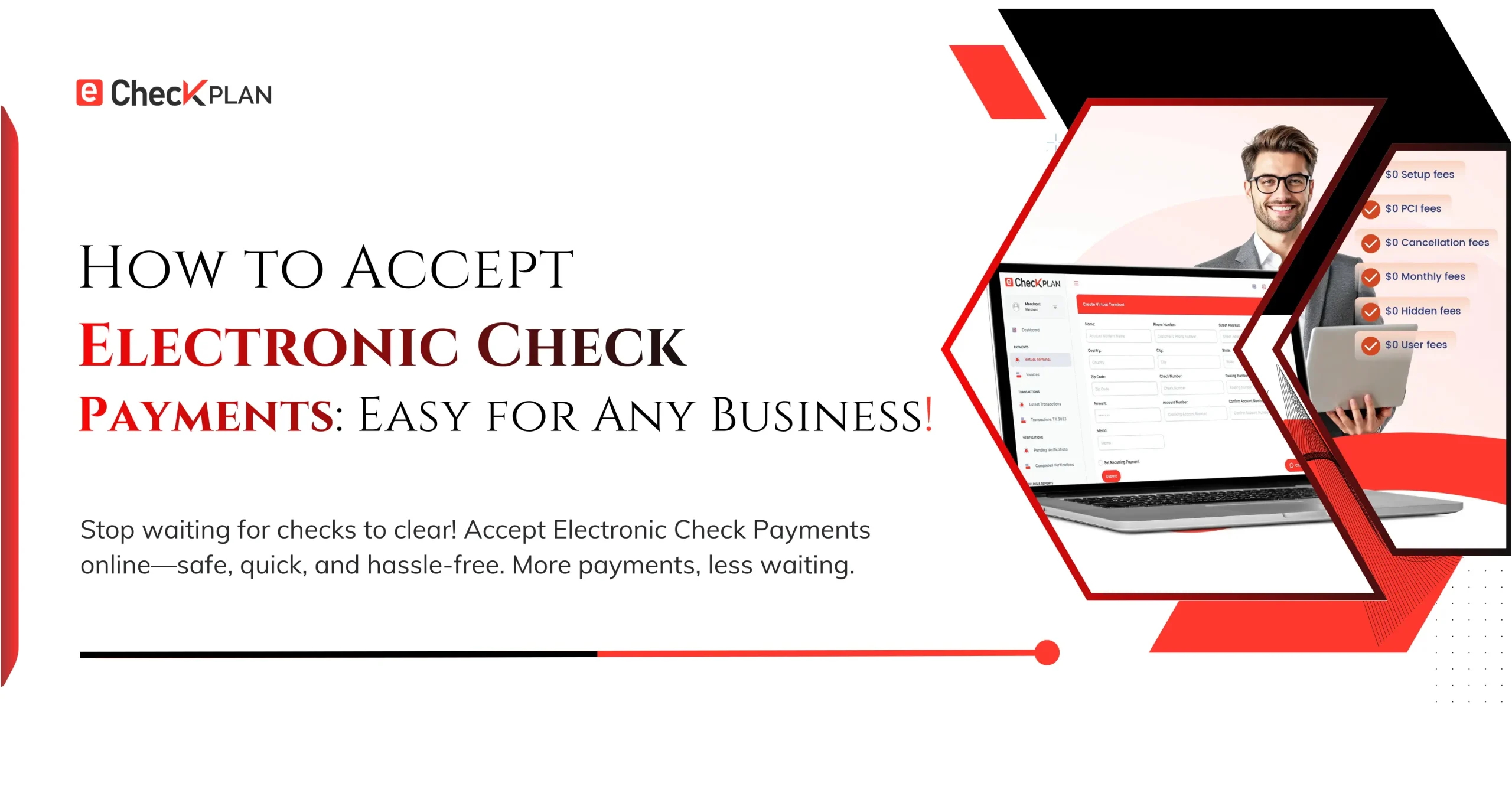
How to Accept Electronic Check Payments— Easy for Any Business!
In today’s digital economy, speed, security, and flexibility define how money moves. Yet even as payment methods evolve, one timeless option—the check—has taken a modern turn.
That’s where Electronic Check Payments (eCheck payments) come in. They offer the familiarity of traditional checks, combined with the efficiency and reliability of modern banking.
If you’re a U.S. business owner searching for a way to reduce payment delays, cut processing fees, and serve customers who prefer paying from their bank accounts, accepting eChecks might be the smartest move you make this year.
Table of Contents: —
- Why Businesses Are Shifting to Electronic Check Payments: —
- Step 1: Choose a Reliable eCheck Payment Processor:
- Step 2: Set Up Your eCheck Merchant Account:
- Step 3: Integrate eCheck Payments into Your Website or Portal:
- Step 4: Accept Payments Through Multiple Channels:
- Step 5: Verify and process the eCheck:
- Step 6: Set Up Recurring and Subscription Billing:
- Step 7: Stay Compliant and Secure:
- Why Electronic Check Payments Are a Smart Move for U.S. Businesses: —
- Frequently Asked Questions About Electronic Check Payments: —
Let’s explore how to accept electronic check payments, step by step—without the jargon.
Why Businesses Are Shifting to Electronic Check Payments: —
Paper checks are fading fast. They’re slow, prone to errors, and require trips to the bank. eChecks, on the other hand, allow funds to move directly between bank accounts using the ACH (Automated Clearing House) network.
For businesses, this means:
- Lower fees than credit card transactions
- Faster settlement times compared to traditional checks
- Less chargeback risk, especially for recurring payments
- Better cash flow control and streamlined reconciliation
From law firms and real estate agencies to e-commerce stores and service providers, eChecks are becoming a trusted and compliant payment solution.
Step 1: Choose a Reliable eCheck Payment Processor:
Before accepting eChecks, your first step is to partner with a reputable eCheck payment processor.
Look for one that specializes in U.S. businesses and follows Check 21 and NACHA compliance standards.
A credible processor will:
- Provide a secure eCheck merchant account
- Offer an online portal or virtual terminal
- Support recurring billing and invoice generation
- Include real-time check verification tools to prevent bounced checks
Avoid processors that charge heavy setup or monthly fees. Some top providers—like those that integrate free website setups or offer no monthly charges—can help startups scale affordably.
Step 2: Set Up Your eCheck Merchant Account:
Once you’ve selected a processor, you’ll need an eCheck merchant account to receive funds.
This account acts as a bridge between your customer’s bank and your business account.
The setup usually involves:
- Submitting your business details and EIN
- Providing bank verification and basic compliance documents
- Getting approval—typically within 24 to 48 hours
After approval, you can start receiving eCheck payments directly through your dashboard or website.
Step 3: Integrate eCheck Payments into Your Website or Portal:
Most modern processors offer API or plugin integrations for websites and e-commerce platforms.
If you’re using WordPress, Shopify, or WooCommerce, the integration process can be completed in a few minutes.
Once integrated, customers can:
- Enter their bank account and routing number securely
- Authorize the transaction digitally
- Receive instant confirmation
This setup gives your business a professional, frictionless payment experience—no manual handling, no paper checks, no delay.
Step 4: Accept Payments Through Multiple Channels:
Don’t limit yourself to just website payments.
With a robust eCheck system, you can accept payments:
- Via phone orders (MOTO)
- Through email invoices
- Using a virtual terminal for in-person transactions
- On subscription or recurring billing models
Each method ensures convenience and flexibility for your customers—especially those who prefer paying directly from their bank rather than using cards.
Step 5: Verify and process the eCheck:
When a customer pays via eCheck, the transaction doesn’t clear instantly like a card swipe.
The bank first verifies the account and authorization before processing the ACH transfer.
Modern eCheck systems automate this step, verifying:
- Account validity
- Sufficient funds
- Proper authorization
Once approved, funds are deposited into your account—typically within 1 to 3 business days.
This process not only prevents fraud but also keeps your payment ecosystem clean and compliant.
Step 6: Set Up Recurring and Subscription Billing:
If your business offers memberships, retainers, or monthly services, eChecks are ideal for automating recurring payments.
They save time and minimize missed payments while reducing card decline rates.
You can set:
- Weekly, monthly, or custom billing cycles
- Automatic notifications before each debit
- Options for customers to update or cancel easily
That’s the kind of payment experience that keeps customers loyal.
Step 7: Stay Compliant and Secure:
Payment compliance isn’t optional—it’s essential.
Ensure your processor follows:
- NACHA rules for ACH transfers
- Check 21 Act for digital check conversion
- PCI DSS standards for data security
Your business should also maintain transparent refund and privacy policies. These small steps reassure customers that their financial data is in safe, compliant hands.
Why Electronic Check Payments Are a Smart Move for U.S. Businesses: —
Businesses today need more than just payment options—they need trust and efficiency.
eChecks bring both.
They lower transaction costs, prevent chargebacks, and reach customers who prefer direct bank payments. Whether you’re a startup or an established company, integrating eChecks enhances your brand’s credibility and makes payments seamless for everyone involved.
If your goal is to grow smarter, not harder—start accepting eChecks today. It’s not just another payment option. It’s your competitive advantage.
Frequently Asked Questions About Electronic Check Payments: —
Yes. You can accept eChecks through a virtual terminal or email invoicing system. Customers simply provide authorization, and funds are processed securely through your processor’s dashboard.
An eCheck is a type of ACH payment, but it specifically mirrors a paper check in digital form. ACH is the broader network that handles many electronic transfers, including payroll and bill payments.
Yes, but approval depends on your processor’s policies. Many high-risk sectors—like supplements, coaching, or subscription services—use specialized high-risk merchant accounts to process eChecks safely.
Use a processor that offers real-time account verification and check screening tools. These systems identify invalid or closed accounts before processing, reducing failed payments.
Keep digital records for at least two years. This protects your business during audits and helps resolve customer disputes with a clear, traceable payment history.
 ChatGPT
 Grok
Grok Claude
 Perplexity
 Google Search