


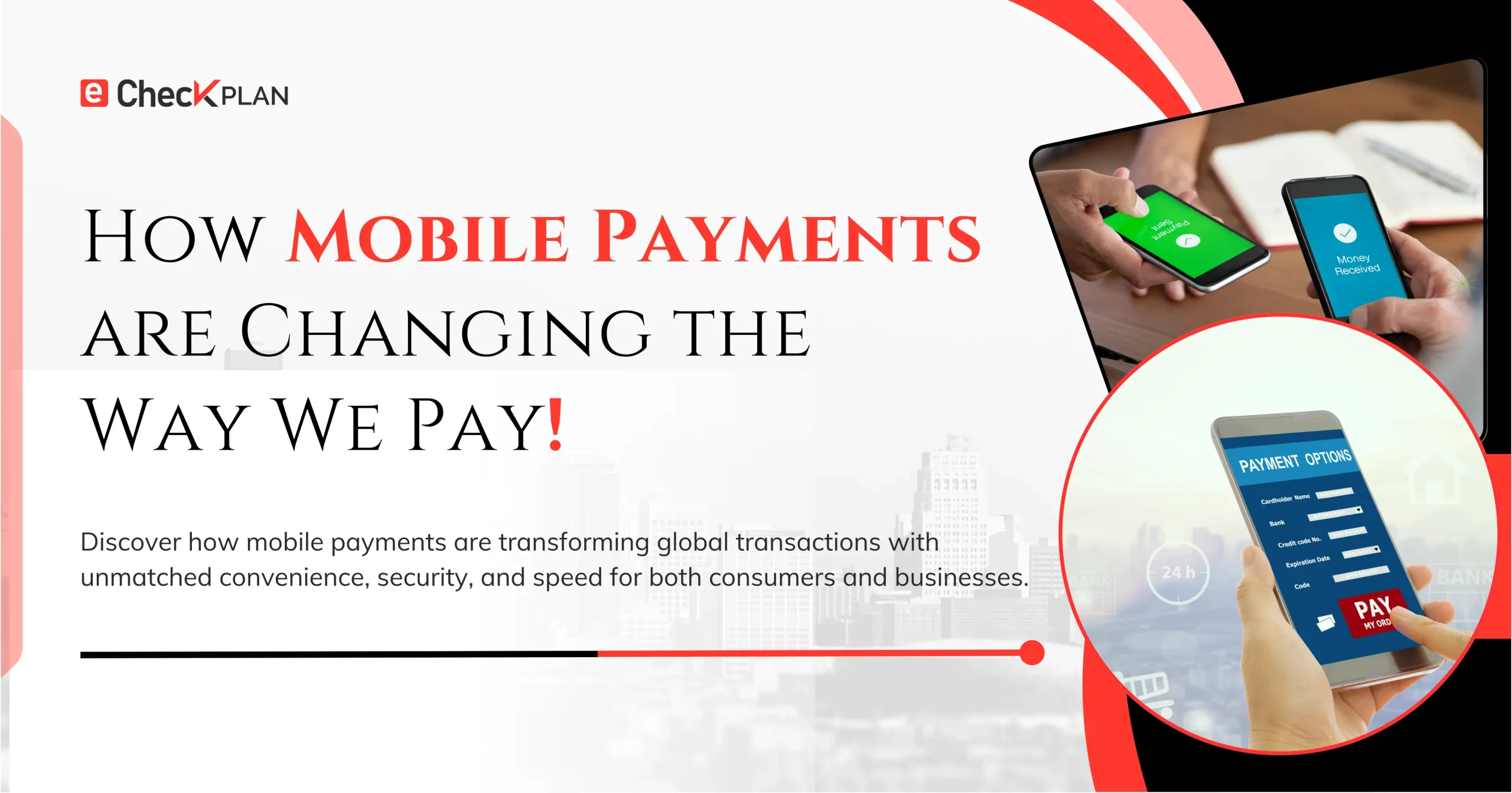
How Mobile Payments are Changing the Way We Pay!
The global payments landscape is rapidly evolving, and mobile payments have been a major driver of this change. With the proliferation of smartphones and other mobile devices, more and more people are relying on their devices for a variety of tasks, including making payments. Mobile payments offer several benefits over traditional methods of payment, such as cash and card payments. They are secure and convenient, allowing customers to pay for goods and services promptly and efficiently. Mobile payments have also become a popular option for businesses.
Currently, over 2.3 billion users globally have made mobile payments an integral part of their lives. The market for mobile payments that was once valued at $1.1 trillion in 2019 is set to increase its value up to $ 9 trillion by 2024. These analytics can even go up owing to the impact of the global pandemic on the payment industry.
To know more about how mobile payments are rising, let’s start from where it begins.
What are mobile payments?
Mobile payments equip us to pay for goods and services and process payments just by using our smartphones. The easy and reliable way to pay made customers happy, as they were able to pay even when they forgot to carry their wallets or were out of cash. These payments also work through mobile wallet apps.
While using mobile wallets, you can save your card information on the device you are using and can fast-track your payment processes. To begin your mobile payment in a minute, you can simply register your bank details, link your account, and boom, your account is made in the wallet. Near Field Communication (NFC) technology enables you to tap a terminal, scan a QR code, or even use your smartwatch or fitness tracker to make payments.
Mobile Pay Timeline – a glance at important events
- 1997– Coca-Cola introduced vending machines with SMS payments. Exxon Mobile introduced Speedpass and used RFID technology to make payments.
- 1998– PayPal is founded.
- 1999– Some mobile phones are used to purchase movie tickets.
- 2001– Domino’s started taking orders through cell phones.
- 2004– Donation to NPO and NGO started through SMS.
- 2009– Square launches its services. The mobile payment market exceeds $ 69 billion in sales.
- 2011– Google introduced the wallet service.
- 2014– Apple introduced Apple Pay.
- 2015 – Samsung Pay and Android Pay are introduced.
- 2016 – Starbucks app becomes one of the most-used mobile payment apps in the U.S., even surpassing Apple Pay in user base at the time. Contactless payment adoption continues to increase across major retailers.
- 2017 – Zelle is launched, allowing real-time peer-to-peer (P2P) transfers directly between bank accounts, gaining traction as a mobile payment solution backed by major U.S. banks.
- 2018 – China leads the mobile payment revolution, with Alipay and WeChat Pay dominating the market. QR code-based payments have become the norm in retail, public transportation, and even street vending.
- 2019 – The global mobile payment market reaches $1.1 trillion, driven by rapid adoption in Asia-Pacific and growing penetration in the U.S. and Europe.
- 2020 – The COVID-19 pandemic creates a surge in contactless and mobile payments, with businesses prioritizing touch-free options. Consumers shift away from cash to digital wallets like Apple Pay, Google Pay, Venmo, and PayPal.
- 2021 – Buy Now, Pay Later (BNPL) services become integrated into mobile wallets, offering flexible payment options directly at checkout. Platforms like Klarna, Affirm, and Afterpay see explosive growth.
- 2022 – Biometric authentication (fingerprint, facial recognition) becomes more common in mobile payments for enhanced security. Apple, Samsung, and Google continue refining wallet experiences with loyalty cards, IDs, and digital tickets.
- 2023 – Tap-to-Pay on iPhone is rolled out, enabling merchants to accept payments with just a smartphone—no extra hardware required. Small businesses benefit by reducing setup costs.
- 2024 – The mobile payments market hits a value nearing $9 trillion globally. AI and machine learning enhance fraud detection and personalize user experiences in mobile wallets. More U.S. cities roll out contactless transit systems, driven by mobile ticketing and NFC technology.
Advantages: –
Contactless payments:
As the name implies, do not involve any physical contact between the device and the reader. The customer has to tap their cards on the machine or wave their phone over the reader to make the payment. These payments are faster and more reliable in comparison to swiping or inserting cards. During the pandemic, contactless payments were the most accelerated payment option and highly boosted the payment industry in 2020.
Companies like Apple, Samsung, and Google have Apple Pay, Samsung Pay, and Google Pay, respectively, to make contactless payments.
Consumer Reliability:
Wallets and mobile payments enable users to opt for discounts, rewards, and offers through various contests or loyalty programs on mobile payment platforms. This reliability and loyalty will be vital for the continued success of mobile payments.
User-Friendly:
Mobile payments are always there for you when you miss your wallet at home or you are out of cash. It also eliminates the inconvenience of carrying around a heavy wallet with cards. Moreover, you don’t have to worry about remembering your card PINs. With your mobile phone, you can complete any transaction easily and conveniently.
Security and Efficiency:
When you add a card to your mobile wallet, the details are not completely stored on the device or the server. Instead, every transaction is end-to-end encrypted by using a unique code for payment verification. These encryption codes will secure all the cardholders’ details and prevent them from being revealed.
Many mobile wallets use biometric authentication for payment security. Rather than the usual password or PIN, mobile wallets provide high security by utilizing behavioral and physiological traits, such as fingerprint, facial features, or voice recognition, to authenticate a user’s identity before verifying the payment. The security, efficiency, and convenience of mobile payment ensure the continuous rise of the industry. With all its value, it can become the go-to mode of payment for consumers. In the coming years, we may see a big revolution in the mobile payment industry itself.
Parting Notes: –
Overall, the rise of mobile payments is revolutionizing the way we pay for goods and services. It is providing customers with greater convenience, security, and control, while also opening up new opportunities for businesses. As mobile payments become more widespread, we will likely see an even greater impact on the payment landscape in the years ahead.
 ChatGPT
 Grok
Grok Claude
 Perplexity
 Google Search