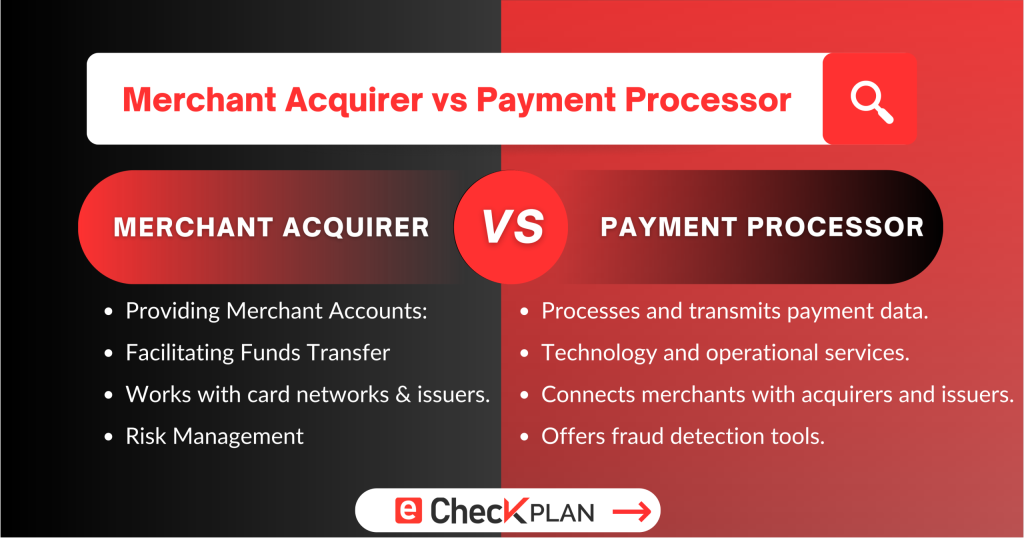
In today’s fast-paced digital world, businesses rely heavily on payment systems to facilitate smooth transactions. Whether you run a small e-commerce shop or a large retail chain, understanding the roles of key players in the payment ecosystem is crucial. Two of the most commonly misunderstood terms in this space are Merchant Acquirer and Payment Processor. We will break down these concepts, explain their differences, and clarify how they work together to make electronic payments seamless.
What is a Merchant Acquirer?
A merchant acquirer, often referred to simply as an acquirer, is a financial institution or a bank that enables businesses to accept credit and debit card payments. Acquirers play a pivotal role in the payment ecosystem by connecting merchants to the card networks like Visa, Mastercard, American Express, and others. Their responsibilities include:
- Providing Merchant Accounts: To accept card payments, businesses need a merchant account, which is offered by the acquirer. This account acts as an intermediary between the business and the payment networks.
- Facilitating Funds Transfer: When a customer pays with a card, the acquirer ensures the funds are transferred from the customer’s bank to the merchant’s account.
- Ensuring Security: Acquirers are responsible for maintaining compliance with PCI DSS (Payment Card Industry Data Security Standards) to protect sensitive payment information.
- Risk Management: They assess and mitigate risks associated with fraudulent transactions and chargebacks.
What is a Payment Processor?
A payment processor is the technology provider that handles the technical side of payment transactions. Think of them as the operational engine that processes and transmits payment data. Payment processors work behind the scenes to:
- Authorize Transactions: When a customer swipes a card or enters payment details online, the processor ensures the cardholder’s bank approves the transaction.
- Transmit Data: They securely send transaction information between the merchant, the cardholder’s bank (issuer), and the acquiring bank.
- Settlement: Payment processors play a role in settling funds by ensuring the correct amounts are debited from customers and credited to merchants.
- Fraud Prevention: Many processors offer tools and services like (Check Verification) to detect and prevent fraudulent activities in real time.
Merchant Acquirers Vs. Payment Processors: –
While merchant acquirers and payment processors often collaborate, they serve distinct purposes. Here’s a breakdown of their key differences:
| Aspect | Merchant Acquirer | Payment Processor |
| Primary Role | Provides merchant accounts and handles fund transfers. | Processes and transmits payment data. |
| Nature of Services | Financial and banking services. | Technology and operational services. |
| Interaction | Works with card networks and issuers. | Connects merchants with acquirers and issuers. |
| Risk Management | Focuses on compliance and chargeback mitigation. | Offers fraud detection tools. |
How Do Both Work Together?
The payment process involves multiple steps, with acquirers and processors collaborating to ensure seamless transactions. Here’s a simplified overview of how they work together:
- Customer Initiates Payment: The customer pays for goods or services using a card.
- Processor Takes Over: The payment processor transmits the transaction data to the card network (e.g., Visa, Mastercard).
- Authorization: The cardholder’s bank (issuer) checks the customer’s account for sufficient funds and approves or declines the transaction.
- Acquirer’s Role: If approved, the merchant acquirer facilitates the transfer of funds from the issuer to the merchant’s account.
- Settlement: The payment processor ensures the transaction is finalized, and the merchant receives the funds.
Choosing the Right Provider
For businesses, choosing the right acquirer and processor is essential. Here are some tips:
- Understand Your Needs: Small businesses might benefit from bundled services offered by providers that act as both acquirers and processors.
- Compare Fees: Acquirers and processors charge different fees, including interchange fees, monthly fees, and transaction fees. Understanding these costs can help you make an informed decision.
- Prioritize Security: Ensure the provider adheres to PCI DSS compliance and offers robust fraud prevention tools.
- Look for Integration: Check if the processor integrates with your existing point-of-sale (POS) system or e-commerce platform.
Final Thoughts
Understanding the roles of merchant acquirers and payment processors is essential for any business that accepts electronic payments. While they perform different functions, their collaboration ensures a smooth and secure payment experience for merchants and customers alike. By choosing the right providers and staying updated on industry trends, businesses can optimize their payment processes and enhance customer satisfaction.

 ChatGPT
 Grok
Grok
 Claude
 Perplexity
 Google Search